Plug-in solarGuide
Solar input on a power station: panel watts, input limits and recharge time
What a solar panel's watt rating means, how a power station's max solar input caps it, why real-world yield comes in lower, and how to estimate recharge time for your station and panels.
Last updated
- 4 power stations
As an Amazon Associate I earn from qualifying purchases. How we make money
Three numbers decide how fast the sun refills a power station: the panel’s watt rating, the station’s max solar input, and how much good sun you actually get. The station only takes as much as its input allows, the panel makes less than its rating outside a lab, and the sun only shines at full strength for part of the day. Our solar recharge calculator puts the three together for the stations and panels in our data.
What a panel’s watt rating means
A panel’s rating is what it produces under standard test conditions: strong, direct light hitting it square-on, with the cells kept cool. It’s a fair way to compare one panel with another. It’s not what you’ll see on a camp table.
The folding panels in our data are rated like this:
- BLUETTI PV200: 200 W
- EcoFlow 220W Bifacial Portable Solar Panel (EF-Fold-G220-04): 220 W
- Jackery SolarSaga 200W (JS-200D): 200 W
Outdoors, several things take that down. The sun is rarely square-on to the panel for long, so unless you re-angle it through the day, output drops as the sun moves. Panels make less when they’re hot, and a dark panel in summer sun gets hot. Haze, clouds, dust on the surface and long cables all take a bit more. Shade is the worst of them: a shadow across part of a panel can cut its output by much more than the share of the panel it covers.
The EcoFlow panel is bifacial, which means its back side can also collect light reflected off the ground. How much that adds depends on what’s underneath it. Light concrete or sand reflects more than grass.
Max solar input: the station’s limit
Every station has a limit on how many solar watts it accepts:
- EcoFlow RIVER 3: 110 W
- EcoFlow DELTA 2: 500 W
- Bluetti AC200PL: 1,200 W
- EcoFlow DELTA Pro: 1,600 W
If your panels add up to more than the input limit, the station takes what it can and the rest goes unused. On the RIVER 3, a single folding panel from the list above is already more than the input takes. On the DELTA Pro, one panel uses only a small part of the input, so adding panels speeds charging up a lot.
Watts aren’t the only limit. The manual also gives a voltage range and a current limit for the solar input. Panels wired in series add their voltages, and panels in parallel add their currents. Go over the voltage limit and you can damage the input, so check the panel’s open-circuit voltage against the station’s range before you chain panels together. Connectors matter too: the Bluetti and EcoFlow panels use MC4, the Jackery uses its own DC8020 plug, and mixing brands often needs an adapter cable.
Peak sun hours
Morning and evening light is weak, so solar figures are usually given in peak sun hours: the day’s total sunlight, counted as if it all arrived at full strength. A long summer day in a sunny place might give several peak sun hours. A winter day further north gives far fewer, and a cloudy one fewer still. Solar maps and weather services publish typical figures by location and month.
How we estimate recharge time
The calculator works it out in two steps. First, hours of full sun to charge from empty: the station’s capacity divided by the panel watts, after capping them at the station’s input limit and cutting them down by a derate factor. The derate covers angle, heat and conversion losses in one number, and it’s on our methodology page. Then it divides those hours by your peak sun hours per day to get days.
It’s an estimate for a station charging from empty with nothing plugged in. If you’re running a fridge or a CPAP off the station while it charges, that power comes out of what the panel delivers, and the battery fills more slowly. Shade and bad weather aren’t in it either. If a full refill takes more than a day of sun, then on a long trip the panels may not keep up with what you use each day, and you’ll want a bigger battery or more panels for the cloudy stretches. Our van and RV sizing guide has more on that.
Getting more out of a panel
Angle it at the sun and turn it a couple of times a day if you’re around. Flat on the ground is easy, but it costs you. And watch for shade from a tent or a roof rack creeping across it in the afternoon.
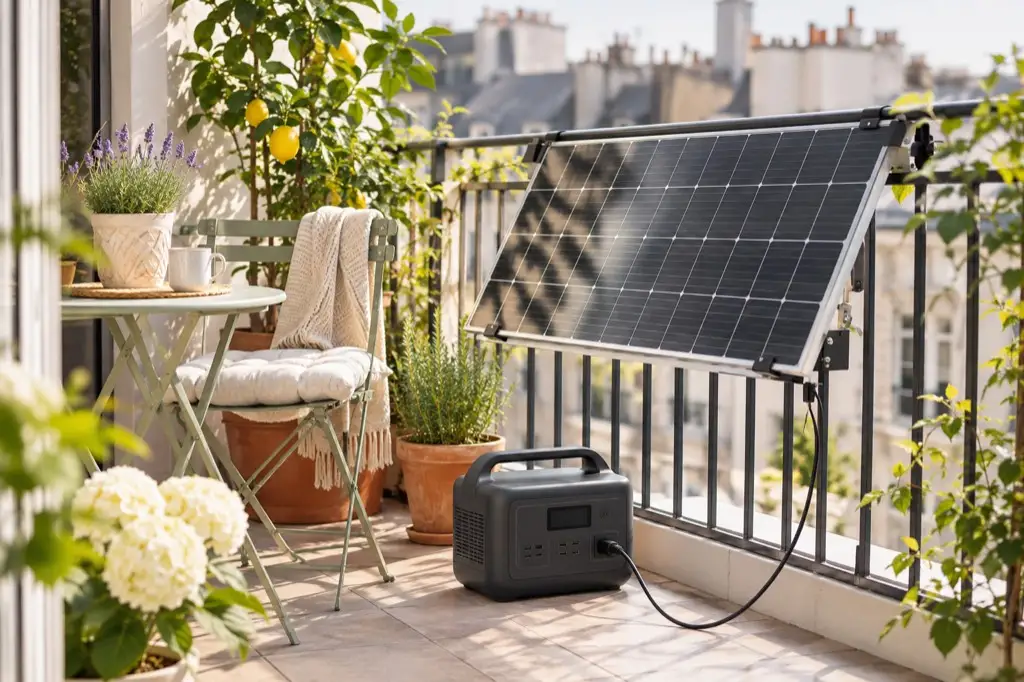
If you’re thinking of a balcony setup, can a portable power station work with plug-in solar? explains why the panel goes into the station’s solar input, not a microinverter.