Plug-in solarGuide
Can a portable power station work with plug-in (balcony) solar?
Why a plug-in solar kit usually can't charge a power station through its AC outlet, what does work, and what the new California and Colorado laws actually allow.
Last updated
- 3 power stations
As an Amazon Associate I earn from qualifying purchases. How we make money
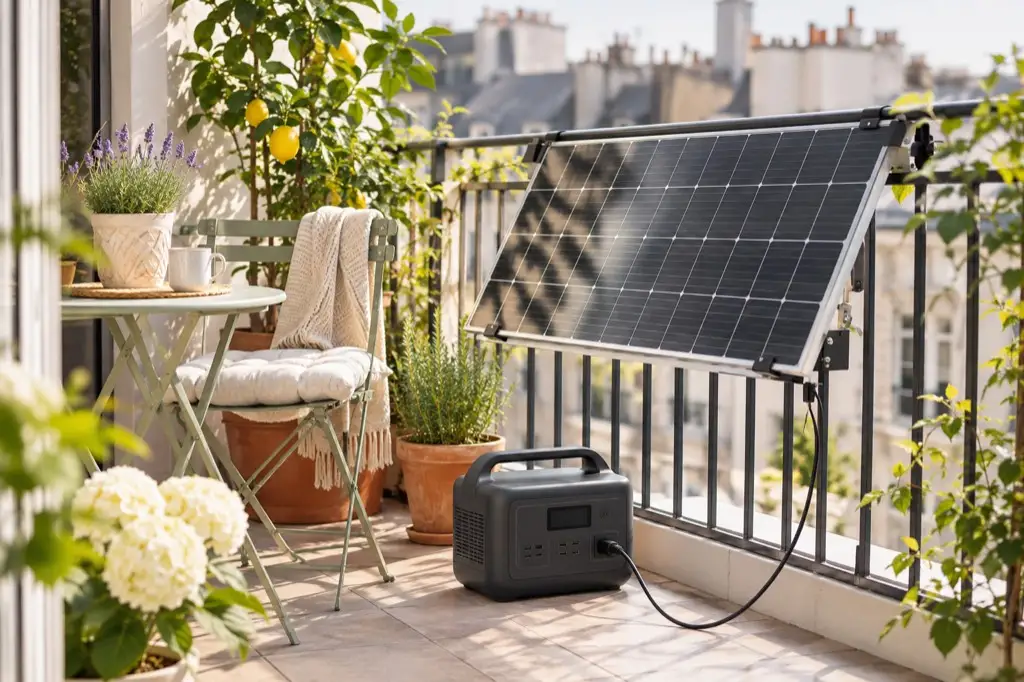
Short answer: not the way most people picture it. A plug-in solar kit is built to push power into a live wall outlet, and a power station’s AC outlet is not a wall outlet. If you want sunlight to end up in a power station’s battery, the panel goes into the station’s solar input, with no microinverter in the way.
The question keeps coming up because two big states just legalized plug-in solar. Both laws have something kicking in on January 1, 2027, though not the same thing, so here’s what they say before we get to the wiring.
What California and Colorado changed
California. Governor Newsom signed SB 868 on September 30, 2026, and it takes effect January 1, 2027. According to pv magazine’s report on the signing, the law covers “portable solar generation devices” that plug into a building’s wiring through a receptacle and offset what the home uses. A single dwelling can have devices with total AC output of up to 1,200 W, and they have to be certified by UL or an equivalent testing lab.
Utilities can’t make you sign an interconnection agreement, ask their permission, or charge a fee. There’s a catch the utilities negotiated, though: pv magazine reports those exemptions sunset in 2030. We couldn’t find anything in the coverage about whether a landlord can still say no, so if you rent in California, read your lease and ask before you hang anything off the railing.
Colorado. HB26-1007 was signed in May 2026, and most of it is already in force. The signed act takes effect 90 days after the legislature adjourned, which it dates to August 12, 2026. It allows one plug-in system per address, designed to send no more than 1,920 W to the grid and listed by a nationally recognized testing lab, with no more than one device on a wall outlet.
Your utility can’t require approval, a fee, or extra equipment, but it can ask you to tell it the system exists and how big it is. In Colorado, January 1, 2027 is the date for two specific parts. From then on, nobody can sell, lease or rent a device over 391 W unless it’s UL labeled and listed. And from the same day, landlords and HOAs can’t “unreasonably” prohibit these devices, though they can still set reasonable rules about notice, fire and overload risk, and where the thing goes.
Utah got there first with HB 340 in 2025, capped at 1,200 W.
All of this is about panels that feed your home’s wiring. Power stations aren’t what these laws were written for.
Why the microinverter won’t charge your station
A plug-in kit is panels plus a microinverter, and the microinverter is grid-tied. It doesn’t make AC on its own. It reads the voltage and frequency already on the outlet, matches them, and pushes current in alongside the grid. When the grid disappears it has to stop. That’s anti-islanding, and it’s there so a line worker fixing a downed wire doesn’t get hit by power coming back from your balcony. An Intertek engineer writing in IAEI Magazine says these systems need anti-islanding so they stop exporting during an outage, and that UL 1741 is where it gets tested. Colorado wrote the same requirement straight into its law.
So in a blackout, a plug-in kit on its own makes nothing, even with the panels sitting in full sun.
Plugging the kit into a power station’s AC outlet doesn’t get around that, and we’d tell you not to try. The likely result is that the microinverter doesn’t see a grid it accepts and stays off. The worse possibility is that it treats the station’s inverter output as a grid and tries to push power back into it. Which one you get depends on the microinverter and the station, and we haven’t tested it. That outlet is an output. Unless the manual says the port can take power in, assume it can’t, and don’t bet a battery on finding out. We have no documentation from Bluetti or EcoFlow saying the Bluetti AC180, Bluetti AC200PL or EcoFlow DELTA 3 Plus supports this, so treat it as unsupported.
What does work
A DC panel into the station’s solar input. That’s what the port is for. The station has its own charge controller, so a folding panel plugs straight in with no inverter between them, and it charges whether the grid is up or not. Here’s how much solar each of our three stations takes, from the manufacturers’ specs:
- Bluetti AC180: 500 W solar input, 1,152 Wh battery
- EcoFlow DELTA 3 Plus: 500 W solar input, 1,024 Wh battery
- Bluetti AC200PL: 1,200 W solar input, 2,304 Wh battery
Folding panels like the BLUETTI PV200 (200 W), the EcoFlow 220W Bifacial Portable Solar Panel (EF-Fold-G220-04) (220 W) or the Jackery SolarSaga 200W (JS-200D) (200 W) are the usual pairing. If you mix brands, check two things first. The plug: the Bluetti and EcoFlow panels use MC4, the Jackery uses Jackery’s own DC8020, so you’ll likely need an adapter cable. And the voltage: wire panels in series and their combined open-circuit voltage has to stay inside the solar input range printed in the station’s manual. Going over it can damage the input. Our solar recharge calculator estimates how long a refill takes.
Both, kept separate. Nothing stops you from running a plug-in kit into the wall and charging a power station from the same wall. On a sunny afternoon the balcony panels cover some of what the station draws while it charges, so part of that charge effectively came off your own roof, or railing. When the grid drops, the kit shuts off and the station runs on whatever it already stored.
A system designed for it. Some companies sell balcony solar with a battery built into the design, where the microinverter and the storage are made to work together. If that’s what you’re after, buy it as a system and follow its manual. We haven’t tested any of these, so we’re not naming one here. Before you buy, find the manufacturer’s own statement about what the system does during a grid outage. If you can’t find one, ask them.
Which one do you actually need?
If you want a smaller power bill, a plug-in kit is the tool, assuming your state allows it and your landlord does too. If you want power when the grid is down, you need a battery, and a power station with a folding panel is the simplest way to get one. We put the two side by side for apartments in plug-in solar vs. a power station with a folding panel.