Plug-in solarComparison
Plug-in solar vs. a power station + folding panel for an apartment
A plug-in solar kit trims your bill but goes dark in a blackout. A power station with a folding panel keeps things running but saves little. How to choose for an apartment.
Last updated
- 3 power stations
As an Amazon Associate I earn from qualifying purchases. How we make money
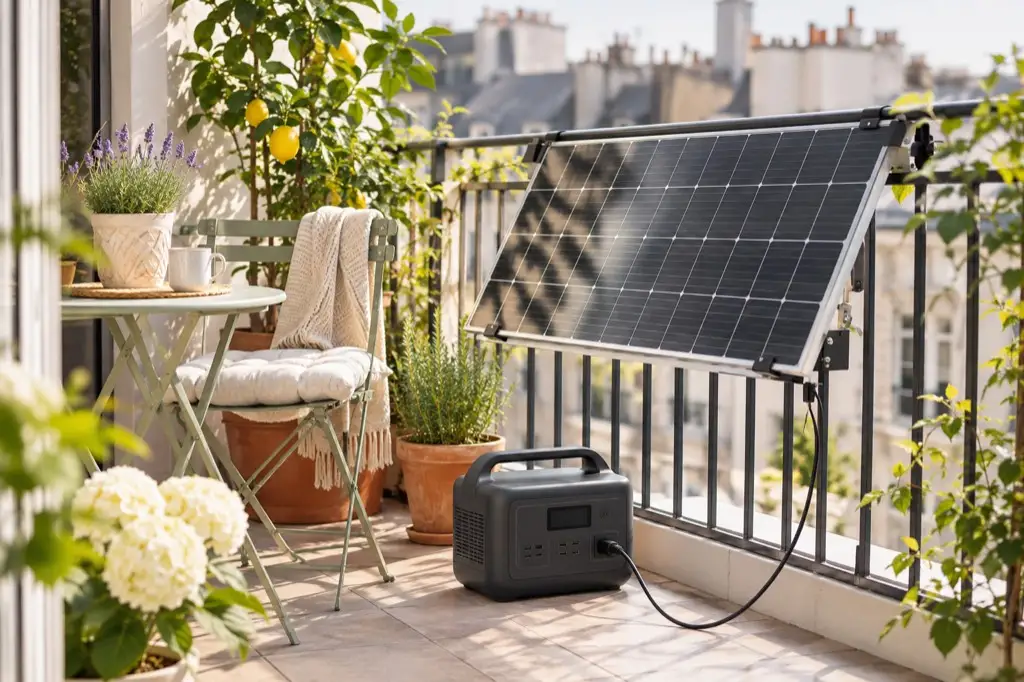
These two get lumped together because both put a solar panel on a balcony, but you’d buy them for different reasons. A plug-in kit chips away at the electric bill. A power station with a folding panel keeps your phone and router going when the power is out. Buy one expecting the other and you’ll be annoyed.
The quick version
A plug-in (balcony) solar kit is panels plus a microinverter that plugs into a regular outlet. Whatever it produces gets used by whatever is running in your apartment at that moment, so your meter turns a little slower. It has no battery. And because the microinverter is grid-tied, it shuts itself off when the grid goes down. It’s meant to work that way, for the safety of line crews, and Colorado’s law spells it out: the device “must include a feature that prevents the device from energizing the electric grid during a power outage.”
A power station is a battery with an inverter and outlets on it. You plug things into it, not it into the wall (except to charge). A folding panel goes into its solar input and refills the battery. It works with the grid down, and you can carry it to a car or a campsite. What it doesn’t do is lower your bill much, because the panel only charges the station and the station only runs what you plug into it.
Is plug-in solar even allowed where you live?
It depends on the state, and it’s changing fast. Utah passed the first law in 2025. California’s SB 868 takes effect January 1, 2027, allowing up to 1,200 W of AC output per dwelling from UL-certified (or equivalent) devices, with no interconnection agreement, utility permission or fee.
Colorado’s HB26-1007 is already mostly in effect, allowing one system per address with up to 1,920 W of grid output. From January 1, 2027, Colorado landlords and HOAs can’t unreasonably prohibit these devices, though they can still set reasonable rules about notice, safety and placement.
For renters, that last part matters more than the wattage. Colorado’s law addresses landlords directly. In the California coverage we read, we didn’t find anything that does, so check your lease and ask before you mount anything. A power station has none of this to worry about. It’s a battery you own, sitting on your floor, and nobody needs to sign off on it.
Side by side
| Plug-in solar kit | Power station + folding panel | |
|---|---|---|
| Lowers your electric bill | Yes, modestly, while the sun is out | Barely |
| Works during a blackout | No, it shuts off by design | Yes, until the battery runs down |
| Stores energy for later | No | Yes |
| Needs a sunny balcony | Yes, more or less permanently | Only on charging days |
| Landlord or HOA question | Often, depending on state and lease | No |
| Portable | Not really, it’s meant to stay put | Yes |
| Runs things that plug into the wall | It feeds the circuit they’re already on | Only what you plug into the station |
What a power station setup looks like
Our three stations all have a solar input, so any of them can pair with a folding panel. The numbers below come from the manufacturers’ manuals:
- EcoFlow DELTA 3 Plus: 1,024 Wh battery, 1,800 W AC output, 500 W solar input
- Bluetti AC180: 1,152 Wh battery, 1,800 W AC output, 500 W solar input
- Bluetti AC200PL: 2,304 Wh battery, 2,400 W AC output, 1,200 W solar input
The first two are the smaller ones and are plenty for small loads like a router, phones, a laptop and a few lights. The Bluetti AC200PL holds about twice as much and takes far more solar, which matters if you want to run bigger things or ride out a longer outage. For a small apartment it’s often more battery than you’ll use.
On the panel side, the BLUETTI PV200 (200 W), EcoFlow 220W Bifacial Portable Solar Panel (EF-Fold-G220-04) (220 W) and Jackery SolarSaga 200W (JS-200D) (200 W) are all one-panel folding designs. A panel’s rating is what it makes in ideal lab conditions. On a balcony with the sun hitting it at an angle for part of the day you’ll get a good deal less, and a north-facing balcony may not be worth bothering with. Our solar recharge calculator lets you plug in your own hours of sun.
Matching brands keeps it simple. The Bluetti and EcoFlow panels use MC4 connectors and the Jackery uses its own DC8020 plug, so cross-brand pairings usually need an adapter cable. Check the station manual’s solar input voltage range too, especially if you plan to chain two panels together.
Can you combine them?
Sort of. You can’t run a plug-in kit’s microinverter into a power station’s AC outlet and expect it to charge the battery. We explain why in can a portable power station work with plug-in solar? What you can do is run both independently: the kit feeds the wall, the station charges from the wall and also from its own folding panel, and in an outage the station keeps going while the kit sits idle. Some companies sell balcony systems with a battery designed in. We haven’t tested those, so we can’t tell you how any particular one behaves when the grid drops.
Which one we’d pick
If you rent, live somewhere with frequent outages, or want something you can take with you when you move, get the power station and a folding panel. The EcoFlow DELTA 3 Plus or Bluetti AC180 with one panel is where we’d start if you mostly care about phones, internet and lights.
If you own your place or have a landlord who’s fine with it, live in a state where it’s legal, and have a balcony that gets real sun most of the day, a plug-in kit is the better way to chip away at the bill. It won’t help in a blackout, though.