12V fridgeGuide
Inverter efficiency, and AC vs DC outputs on a power station
Why power from a station's AC outlets costs more battery than the same power from its 12V or USB ports, how much difference that makes in our numbers, and when the AC outlet is still the right choice.
Last updated
- 3 power stations
- 2 devices
As an Amazon Associate I earn from qualifying purchases. How we make money
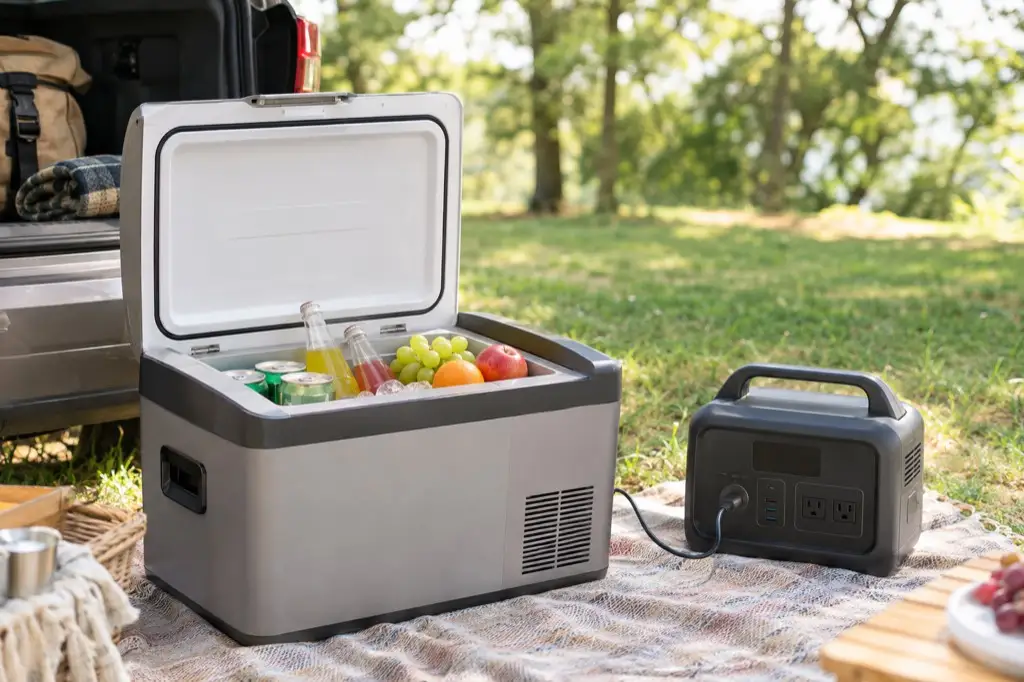
A power station’s battery stores DC. Its AC outlets need an inverter to turn that into the AC your wall outlets supply, and the inverter loses some energy as heat while it works. The 12V car port and the USB ports skip that step. So whenever an appliance can run from DC, it usually gets more hours from the same battery that way. The catch is that the DC ports have their own limits, and plenty of things only run on AC.
Where the energy goes on the AC path
The inverter’s conversion loss is the obvious one. Some of every watt-hour becomes heat in the inverter instead of reaching the outlet.
Then there’s the inverter’s own draw. It uses some power just to be on, whatever is plugged in. That’s why inverters are usually least efficient at very light loads: a small appliance running all night spends a bigger share of the battery keeping the inverter awake than a big one does.
And many appliances don’t run on AC at all inside. A laptop, a CPAP or a 12V fridge plugged into an outlet uses a power brick to turn the AC straight back into DC. That brick loses a bit more. So on the AC path, the power gets converted twice before it reaches the machine.
The DC path
The 12V car port isn’t free either. The battery runs at its own voltage, and a converter inside the station turns that into 12V, which loses something. But it’s one conversion instead of two, and there’s no inverter idling.
USB-C ports work the same way. If your laptop charges over USB-C, plugging it into the station’s USB-C port instead of using its AC brick skips the same double conversion. We don’t carry USB port ratings in our data yet, so check the station’s manual for what its USB-C ports can supply.
How big the difference is in our numbers
We use one flat efficiency factor for AC and one for DC, the same for every station unless the maker publishes a figure. They’re listed in the note under each table. Here’s a Dometic CFX3 45, which can run either way:
The Dometic CFX3 45 runs on AC power for 70.5 to 247.5 hours and on 12V DC for 74.5 to 262.0 hours, depending on the power station and mode.
| Power station | Rated capacity (Wh) | Mode | Power path | Runtime (hours) |
|---|---|---|---|---|
| EcoFlow DELTA 2 | 1,024rated spec | 12 V, 32 C ambient, 4 C internal | AC | 70.5calculatedsurge unverified: Startup surge not specified |
| EcoFlow DELTA 2 | 1,024rated spec | 12 V, 32 C ambient, 4 C internal | 12V DC | 74.5calculatedsurge unverified: Startup surge not specified |
| Bluetti AC180 | 1,152rated spec | 12 V, 32 C ambient, 4 C internal | AC | 79.0calculatedsurge unverified: Startup surge not specified |
| Bluetti AC180 | 1,152rated spec | 12 V, 32 C ambient, 4 C internal | 12V DC | 84.0calculatedsurge unverified: Startup surge not specified |
| EcoFlow DELTA Pro | 3,600rated spec | 12 V, 32 C ambient, 4 C internal | AC | 247.5calculatedsurge unverified: Startup surge not specified |
| EcoFlow DELTA Pro | 3,600rated spec | 12 V, 32 C ambient, 4 C internal | 12V DC | 262.0calculatedsurge unverified: Startup surge not specified |
Last updated 2026-11-13. Bars are scaled to the longest runtime in this table. Assumptions: AC efficiency 85% assumed; Average load from 297 Wh per day ÷ 24; 12V DC efficiency 90% assumed. How we calculate runtime
The 12V rows come out longer on every station. The gap is only as big as the difference between our two factors, and it doesn’t include the fridge’s own AC adapter loss, so if anything the AC rows flatter the AC path. Real inverters vary, and their efficiency changes with the load, which one flat factor can’t show. Treat the gap in the table as a rough guide, not a measured result. Our methodology page has the formula.
For a CPAP the logic is the same, and the difference runs all night. We go through it machine by machine in why a CPAP gets more hours from a DC adapter.
When DC isn’t an option
The 12V car port has an amp limit, and on every station in our data it’s 10 A. The bigger stations in our data don’t get a bigger car port. Divide an appliance’s watts by 12 and you have roughly the amps it pulls from that port. Dometic rates the Dometic CFX3 95DZ above that limit. Our check still says yes, but only because the AC outlet works. The Why column shows the 12V port failing:
2 of 2 power stations below can run the Dometic CFX3 95DZ in every listed mode.
| Power station | Mode | Runs it? | Why |
|---|---|---|---|
| EcoFlow DELTA 2 | 12 V, 32 C ambient, 4 C internal | Yes (surge unverified) | AC: 124.8 W is within the 1,800 W inverter limit; AC: Startup surge not specified; 12V DC: Draws 10.4 A at 12V, port limit is 10 A |
| EcoFlow DELTA Pro | 12 V, 32 C ambient, 4 C internal | Yes (surge unverified) | AC: 124.8 W is within the 3,600 W inverter limit; AC: Startup surge not specified; 12V DC: Draws 10.4 A at 12V, port limit is 10 A |
Last updated 2026-11-13. How we check compatibility
Anything built for a wall outlet with no DC version, like a kettle, a microwave or most power tools, has to use AC. For those, inverter efficiency is just part of the cost, and the questions that matter are whether the inverter’s continuous and surge ratings are big enough. Surge watts, explained covers the second one.
Getting more out of the AC path
If you do use the AC outlets, turn them off when nothing is plugged in. On many stations the AC side has its own button, and leaving it on means the inverter keeps drawing power for nothing. Some stations also have a timer that switches the AC off when it sees no load. Your manual shows how.
And if you have one big AC load and several small DC ones, run the small ones from the DC ports. You’ll get more out of the battery than you would by plugging everything into a power strip on the AC outlet.