CPAPComparison
EcoFlow RIVER 3 Plus vs Bluetti EB3A
Battery, AC output, surge and solar input compared for the EcoFlow RIVER 3 Plus and Bluetti EB3A, plus how long each runs a CPAP, a Starlink Mini, a laptop and a small 12V fridge.
Last updated
- 2 power stations
- 8 devices
As an Amazon Associate I earn from qualifying purchases. How we make money
This page sizes a power supply. It is not medical advice. Check your CPAP manual and talk to your equipment supplier before relying on battery power overnight.
On paper these two are nearly the same station. Same inverter rating, same car port limit, same battery chemistry. The EcoFlow RIVER 3 Plus holds a little more and takes a little more solar, so it comes out slightly ahead in every runtime table below. The difference that might actually decide it is a line on the spec sheet we only have for one of them: Bluetti publishes a surge rating for the Bluetti EB3A, and EcoFlow doesn’t publish one for the RIVER 3 Plus.
Specs side by side
| EcoFlow RIVER 3 Plus | Bluetti EB3A | |
|---|---|---|
| Battery capacity | 286 Wh | 268.8 Wh |
| Battery chemistry | LiFePO4 | LiFePO4 |
| AC output, continuous | 600 W | 600 W |
| AC surge | Not given in EcoFlow’s manual | 1,200 W |
| 12V car port | 10 A | 10 A |
| Max solar input | 220 W | 200 W |
A word on the surge row. EcoFlow’s manual gives no surge figure for the RIVER 3 Plus. It does mention X-Boost, but X-Boost isn’t a surge rating, so we don’t treat it as one. When our tables check a startup draw against the RIVER 3 Plus, they use its continuous rating as the limit. That’s us being cautious, not a number from EcoFlow, and the station may well handle short spikes above it. We just can’t tell from the manual.
On this page that caution never changes a result, because none of the appliances below come with a startup figure. It matters when you plug in something with a motor or compressor that kicks hard when it starts. For that, the EB3A at least gives you a published number to check against. Our guide to surge watts explains why the startup draw can be the thing that trips a small inverter.
CPAP
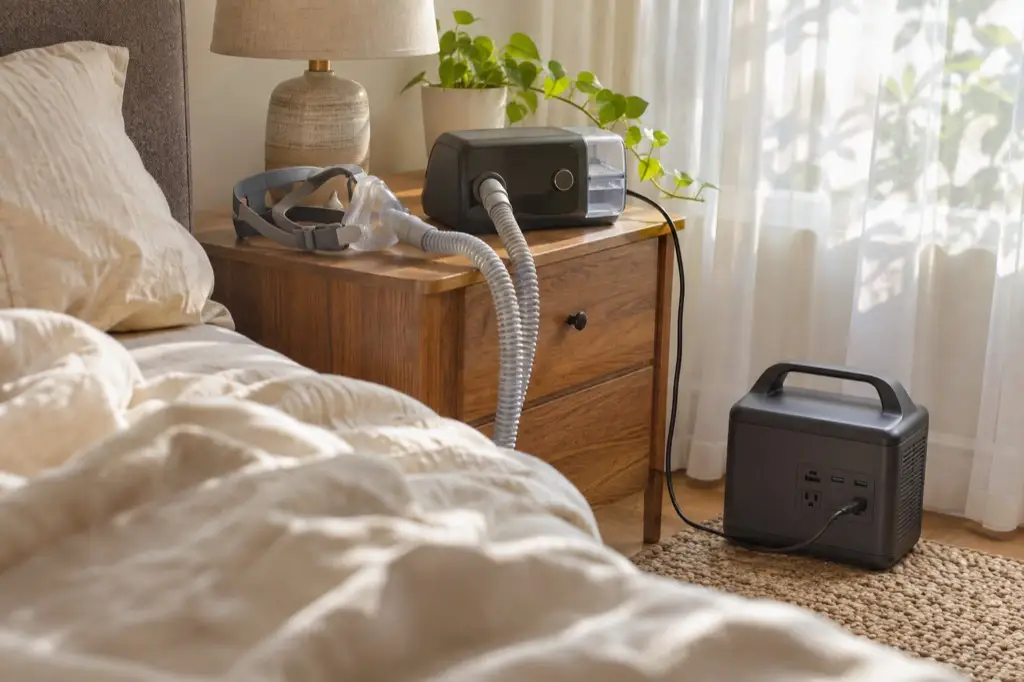
The ResMed AirSense 11 runs on AC power for 4.0 to 4.5 hours and on 12V DC for 4.5 hours, depending on the power station and mode.
| Power station | Rated capacity (Wh) | Mode | Power path | Runtime (hours) |
|---|---|---|---|---|
| EcoFlow RIVER 3 Plus | 286rated spec | Typical power consumption (manufacturer figure) | AC | 4.5calculatedsurge unverified: Startup surge not specified |
| EcoFlow RIVER 3 Plus | 286rated spec | Typical power consumption (manufacturer figure) | 12V DC | 4.5calculatedsurge unverified: Startup surge not specified |
| Bluetti EB3A | 268.8rated spec | Typical power consumption (manufacturer figure) | AC | 4.0calculatedsurge unverified: Startup surge not specified |
| Bluetti EB3A | 268.8rated spec | Typical power consumption (manufacturer figure) | 12V DC | 4.5calculatedsurge unverified: Startup surge not specified |
Last updated 2026-11-13. Bars are scaled to the longest runtime in this table. Assumptions: AC efficiency 85% assumed; 12V DC efficiency 90% assumed. How we calculate runtime
On 12V with ResMed’s DC adapter, the ResMed AirSense 11 gets 4.5 hours from the RIVER 3 Plus and 4.5 hours from the EB3A. That’s ResMed’s typical figure, not a worst case, and it’s still short of a full night for a lot of people. These are small stations, and a full-size CPAP shows it.
The ResMed AirMini is a different story. It draws so little that either station runs it for 41.0 hours (RIVER 3 Plus) or 38.5 hours (EB3A) on 12V. If you travel with an AirMini, a station this size makes sense. If you use a bedside machine, look at our CPAP runtime table for the bigger stations.
Starlink Mini and a laptop
The Starlink Mini runs on AC power for 5.5 to 6.0 hours and on 12V DC for 6.0 to 6.5 hours, depending on the power station and mode.
| Power station | Rated capacity (Wh) | Mode | Power path | Runtime (hours) |
|---|---|---|---|---|
| EcoFlow RIVER 3 Plus | 286rated spec | Average power consumption (manufacturer range 25-40 W, upper end used) | AC | 6.0calculatedsurge unverified: Startup surge not specified |
| EcoFlow RIVER 3 Plus | 286rated spec | Average power consumption (manufacturer range 25-40 W, upper end used) | 12V DC | 6.5calculatedsurge unverified: Startup surge not specified |
| Bluetti EB3A | 268.8rated spec | Average power consumption (manufacturer range 25-40 W, upper end used) | AC | 5.5calculatedsurge unverified: Startup surge not specified |
| Bluetti EB3A | 268.8rated spec | Average power consumption (manufacturer range 25-40 W, upper end used) | 12V DC | 6.0calculatedsurge unverified: Startup surge not specified |
Last updated 2026-11-13. Bars are scaled to the longest runtime in this table. Assumptions: AC efficiency 85% assumed; 12V DC efficiency 90% assumed. How we calculate runtime
Starlink gives a range for the Mini’s average draw, and we use the top of it. If your Mini draws less than that, you get more hours than this. The 12V rows assume you have Starlink’s DC cable for the car port. Our Starlink page goes into that.
Laptops are harder to pin down, because the makers only publish the charger rating, which is the most the laptop can pull, not what it usually draws. Taking those ratings at face value, the Apple MacBook Air 13-inch (M4, 2025) gets 8.0 hours on the RIVER 3 Plus and 7.5 hours on the EB3A. The Apple MacBook Pro 16-inch (2024, M4 Pro/Max) gets 1.7 hours and 1.6 hours. Treat both as floors. A laptop doing ordinary work will usually go a lot longer than that. More on why in our laptop runtime page.
A small 12V fridge
The Dometic CFX3 25 runs on AC power for 20.5 to 22.0 hours and on 12V DC for 22.0 to 23.5 hours, depending on the power station and mode.
| Power station | Rated capacity (Wh) | Mode | Power path | Runtime (hours) |
|---|---|---|---|---|
| EcoFlow RIVER 3 Plus | 286rated spec | 12 V, 90 F ambient, 39 F internal | AC | 22.0calculatedsurge unverified: Startup surge not specified |
| EcoFlow RIVER 3 Plus | 286rated spec | 12 V, 90 F ambient, 39 F internal | 12V DC | 23.5calculatedsurge unverified: Startup surge not specified |
| Bluetti EB3A | 268.8rated spec | 12 V, 90 F ambient, 39 F internal | AC | 20.5calculatedsurge unverified: Startup surge not specified |
| Bluetti EB3A | 268.8rated spec | 12 V, 90 F ambient, 39 F internal | 12V DC | 22.0calculatedsurge unverified: Startup surge not specified |
Last updated 2026-11-13. Bars are scaled to the longest runtime in this table. Assumptions: AC efficiency 85% assumed; Average load from 265 Wh per day ÷ 24; 12V DC efficiency 90% assumed. How we calculate runtime
Dometic’s daily figure for the Dometic CFX3 25 is for a hot day, so a cooler one should stretch it. Even so, on either station you’re looking at roughly a day of cooling with no charging. That’s fine for an overnight trip. For anything longer you’d want solar or a charge while you drive, which brings us to the one place the RIVER 3 Plus pulls a little further ahead.
Solar
The RIVER 3 Plus takes a bit more solar than the EB3A. With one small folding panel that probably makes no difference, because the panel limits you before either station does. The gap only shows if you bring enough panel to go past the EB3A’s limit. Our solar recharge calculator will tell you whether your panel does.
What neither one runs
A small inverter rules out the big heating loads. The Hamilton Beach Coffee Maker 46290 has the lowest rated power of the coffee makers in our data, and neither station can run it:
0 of 2 power stations below can run the Hamilton Beach Coffee Maker 46290 in every listed mode.
| Power station | Mode | Runs it? | Why |
|---|---|---|---|
| EcoFlow RIVER 3 Plus | Brewing, rated electrical power (manufacturer label figure) | No | AC: Needs 900 W, inverter limit is 600 W |
| Bluetti EB3A | Brewing, rated electrical power (manufacturer label figure) | No | AC: Needs 900 W, inverter limit is 600 W |
Last updated 2026-11-13. How we check compatibility
The same goes for every microwave in our data. One thing does squeeze in. The EcoFlow WAVE 2 fits under both inverter limits at its rated cooling input, but not at maximum cooling:
The EcoFlow WAVE 2 runs on AC power for 0.4 hours, depending on the power station and mode.
| Power station | Rated capacity (Wh) | Mode | Power path | Runtime (hours) |
|---|---|---|---|---|
| EcoFlow RIVER 3 Plus | 286rated spec | Cooling, rated input (AC) | AC | 0.4calculatedsurge unverified: Startup surge not specified |
| EcoFlow RIVER 3 Plus | 286rated spec | Cooling, maximum power | AC | Won't run (Needs 700 W, inverter limit is 600 W) |
| Bluetti EB3A | 268.8rated spec | Cooling, rated input (AC) | AC | 0.4calculatedsurge unverified: Startup surge not specified |
| Bluetti EB3A | 268.8rated spec | Cooling, maximum power | AC | Won't run (Needs 700 W, inverter limit is 600 W) |
Last updated 2026-11-13. Bars are scaled to the longest runtime in this table. Assumptions: AC efficiency 85% assumed. How we calculate runtime
We wouldn’t build a trip around that. The runtime is short, the margin is thin, and EcoFlow doesn’t publish a startup figure for the WAVE 2, so we can’t check the start against either station. On the RIVER 3 Plus we can’t check it at all.
Picking between them
Pick the RIVER 3 Plus if you want the slightly bigger battery and you’ll be charging from a panel big enough to use its higher solar limit. Pick the EB3A if you plan to plug in something with a motor or compressor and want a published surge rating to check it against. For a CPAP, a Starlink Mini or a laptop, the hours are close enough that neither of those should be what decides it.
We don’t carry weight, size, port layout or wall charging speed in our data. For stations this small, those are often the reason people pick one, so check both manuals.